
"Turmeric relieves joint pain." A health magazine can publish this sentence. The manufacturer of turmeric capsules cannot. Same claim, same plant, two different legal regimes.
The regulations do not judge the veracity of the statement. They judge who utters it, and for what purpose.
Three categories, three levels of risk
A health claim links a food or one of its components to an effect on the body. "Magnesium contributes to the normal functioning of the nervous system" is one example.
Don't confuse it with the nutritional claim, which only describes the composition. "High in fiber," "source of calcium." The latter tells you what the product contains, not what it does.
The third category is the expensive one. A therapeutic claim attributes to the product the power to prevent, treat, or cure a disease. For a food or supplement, it is prohibited without exception.
The problem goes beyond the fine. A product sold with a promise of treatment becomes, under the law, a medicine by presentation. It would then require marketing authorization, which no one applies for a herbal capsule.
A claim can also be conveyed through an image, a product name, or a pictogram. Calling a supplement "Articul'Confort" and illustrating it with a painful knee produces the same effect as a written sentence.
How an allegation becomes permissible
Two European texts govern the system. Regulation (EC) No 1924/2006 on nutrition and health claims establishes the principle: no claim without validated scientific evidence. Regulation 432/2012 published the first list of claims that have passed the examination, comprising 222 formulations.
This list has grown since then. EFSA now has over 260 approved claims, with more than 70% of applications rejected due to insufficient evidence. This rejection rate reflects the core of the regulatory standards.
The EFSA assesses, the European Commission decides, and the result is available in the European Register of Health Claims . In France, the DGCCRF monitors what information is actually displayed on labels and online marketplaces.
The regulations also dictate the wording. You must use the authorized phrase, or a variant that maintains the exact same meaning for the consumer. "Magnesium contributes to the normal functioning of the nervous system" can become "magnesium supports the nervous system." It cannot become "magnesium calms anxiety."
The rule that many brands ignore
Simply finding the nutrient on the list is not enough. It must also be present in a significant quantity in the product.
The threshold corresponds to that of the "source of" claim, i.e., 15% of the reference intake per recommended daily allowance. Below this threshold, you lose the right to make the claim, even if the list permits the phrase.
The checks confirm this. In a DGCCRF investigation into food supplements, 10% of the non-conformities noted specifically concerned claims that were unjustified by excessively low levels.
This rule eliminates a common practice: adding a pinch of vitamin C to a herbal formula to validate its claims. The vitamin must reach the required threshold. On our dietary supplement formulas , it is this dosage that determines what we are allowed to write, not the other way around.
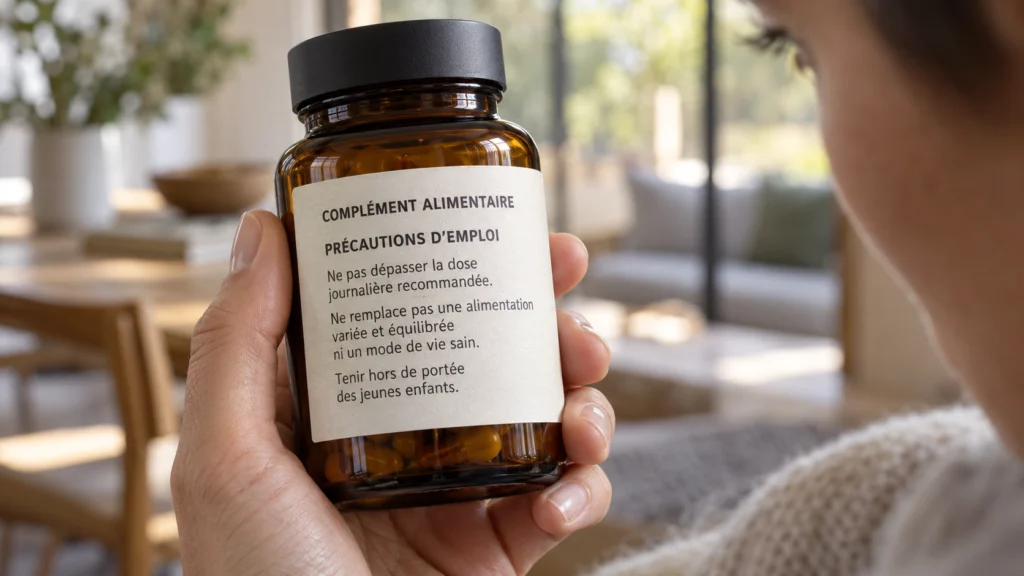
The regulation also requires certain mandatory information to be included around the claim, including a reminder that a supplement is not a substitute for a varied diet. The DGCCRF's practical guide on food supplement labeling details these requirements. Brands often omit them in their social media posts, where the text is shorter.
Why do plants get stuck?
Look for turmeric in the European register. You won't find it. The same goes for pomegranate, black cumin, ginseng, and artichoke.
These plants were not rejected. Their evaluation has been suspended since 2010 due to a lack of agreement on the methodology to be applied to botanical substances. The files are still pending.
For a manufacturer, the result is the same as a rejection. No health claims can be made about a plant that is not yet approved. Brands that operate ethically therefore describe the plant by its composition and processing method, then link their claims to a specific vitamin or mineral in the formula.
Our Curcumisan Plus fermented turmeric capsule illustrates this breakdown. The turmeric is described by its curcuminoid content and its fermentation process. The vitamin C in the same formula claims to protect cells against oxidative stress. The marketing claim is there, it simply doesn't refer to the plant itself.
The more you sell, the less you talk
Regulation 1924/2006 governs commercial communication about food. Your freedom of speech decreases as your financial interest in the product increases.
Sellers are subject to the strictest regulations across all their marketing materials: labels, product descriptions, emails, advertisements, and social media. A DGCCRF (French Directorate General for Competition Policy, Consumer Affairs and Fraud Control) investigation of online marketplaces uncovered unauthorized health claims from 33 inspected operators. Penalties can be severe: the DGCCRF issued fines of €300,000 and €100,000 against two companies for supplements marketed with purported medical benefits.
Google then applies its own interpretation. A merchant site that associates its product with a disease is demoted in search results and rejected from Merchant Center. In practice, this penalty is applied well before any administrative action.
A health media outlet operates under a different system. A journalist reporting on a study informs, they don't sell. A patient association discusses illness as part of its mission. A research foundation publishes its findings.
The shift occurs as soon as a commercial link appears. An article that cites a study remains informational. The same article with a purchase button becomes an advertisement and falls under the regulations.
A doctor has genuine freedom to inform the public about a disease. Their code of ethics requires them to be cautious, not silent. This freedom ends with promotion: they cannot lend their title to the sale of a product. The DGCCRF (French Directorate General for Competition Policy, Consumer Affairs and Fraud Control) has, in fact, noted, among the observed breaches, claims presented as recommendations from doctors or healthcare professionals. This distinction is important for a laboratory run by a healthcare professional: presenting the founder as the formulator is safe, but using their title to sell products is not.
Influencers have lost their legal loophole with the law of June 9, 2023. Sponsored content is now considered full-fledged commercial communication, subject to the same prohibitions as advertising. The creator who claims a capsule cured her eczema is liable, and the brand that paid her is also liable.
Things to check before publishing
Start with your status. If you have a commercial interest in the product, the strict regime applies, regardless of the format used.
Next, check if your sentence relates to an illness. Prevent, relieve, treat, cure: these verbs take you out of bounds.
Finally, identify the nutrient that makes your claim. If it's a vitamin or mineral, compare your formulation to the one in the European register and check the dosage. If it's a plant, you probably have no right to promise any effect.
These checks take ten minutes per page. A Google ranking penalty on a product page takes months. To see how a text written under this constraint performs, read our guide to joint supplements.