

If it is necessary throughout your life to be vigilant for your bones, it is essential from a certain age to take particular care of them to avoid inconvenience, even serious worries, and to put all the chances on your side for good to get old.
Indeed, in the fifties, osteoporosis awaits!
What is osteoporosis?
Osteoporosis is a fragility of the bones and their tissues that comes with age and deteriorates with age. The bones become so fragile that they become brittle, even with small shocks, a fall or a blow, resulting in severe pain and disability.
What is terrible with this disease is that there are no detectable symptoms before a fracture. It is therefore essential to take care of your bones throughout your life, but especially when you reach your fifties!
A COMMON DISEASE
And this disease is unfortunately widespread, as something quite inevitable with age. It is estimated that one third of women and half of men suffer from a fracture due to osteoporosis. These figures increase at the same time as life expectancy increases of course.
Preventive measures are therefore important, and are beginning to be developed among the populations, fortunately.
Four tips to prevent osteoporosis
Osteoporosis arises and increases due to several causes. While some causes are difficult to control, such as heredity, passing years or even previous illnesses that may have triggered or aggravated this illness, others can be controlled and therefore you have the power to act to prevent this illness.
These causes are related to your daily lifestyle, namely your diet, your activity, your overall health or even certain addictions such as cigarettes.
We detail below how you can act!
Tip number 1: move, do sports or an activity!
Have you ever been a sports enthusiast? Or over the years, has your practice dwindled or even become absent today?
Hey! well if you are reaching your fifties or are already there, or even have passed it, it may still be time to get started or get back into it because sport, in addition to your general health, will have an extremely positive effect on prevention of osteoporosis!
Indeed, regular exercise will not only allow you to maintain good bone mass, but also improve your muscle strength. Why is this important? Muscular strength will allow you to be better balanced and stronger, thus avoiding falls, as seen above, with a risk of fractures caused by osteoporosis.
In addition, exercising will allow your bones to increase in mineral density, even as you age. Of course, especially if you have not practiced sport in your life, you will have to choose activities according to your abilities, the main thing being to move. From daily walking to exercises at home, a lot is possible.
If you already suffer from osteoporosis, in order to avoid falls and pain, do not start practicing sports.
Tip number 2: take care of your diet, to nourish your bones
You may remember when you were a child you were told that you needed lots of calcium and vitamin D for your growth, our bones needed it.
Hey! well as you age, it's the same, your bones need these resources to be healthy! Why ? First of all calcium.
It is one of the basic elements of the constitution of our bones, the latter also concentrating almost all the calcium found in our body! It is from the bones that the body draws the necessary calcium.
Even if you have never ceased all your life to be careful to eat foods rich in calcium, this must become a concern in your fifties because with age, unfortunately, our body assimilates less well and we must increase our consumption of calcium.
Vitamin D
it is also very important because it will greatly help the fixation of calcium on our bones. They are therefore both essential for our good health!
Besides these two elements, proteins will also be beneficial for the good health of our bones.
Tip number 3: pay attention to your weight and bad habits
Whether for your general health but also for your bones, three bad habits are particularly harmful, even if they are not always easy to regulate: tobacco, alcohol and your weight.
In general, you know the dangers of tobacco on your health. Here is perhaps an additional argument which will make you stop. Indeed, smoking worsens the factors of appearance of osteoporosis, as for the menopause.
For alcohol, we are on the same causes, the same effects. However, a low, moderate consumption such as 1 to 2 glasses of wine per day will not have an impact on the health of your bones, excessive and regular consumption will have harmful consequences for your bones.
Finally, to avoid the risk of fractures and osteoporosis, it is essential to maintain a balanced weight. Maintaining the correct weight is important. In fact, being too thin increases the risk of fracture due to the lack of muscle strength and balance, and being overweight puts weight on your bones.
Tip number 4: a food supplement made for you and your joints: Faran
All these tips and recommendations are not necessarily easy to follow even if they are essential for your general good health and your bones. Whatever the age in any case, it is always possible to change your habits! Retirement can also be a good start to do or redo sports, take care of your diet or even banish bad habits, even if it is important to start in your fifties.
So don't be afraid to help yourself a little with a food supplement, if it is natural of course.
Faran, the dietary supplement developed by Phytomisan laboratories, is totally natural, derived from plants and nutrients that will be beneficial for your bones, but also for your joints, muscles and tendons.
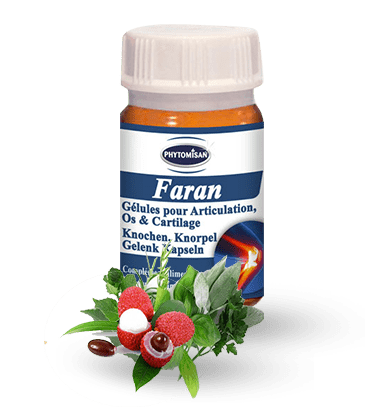
No less than 22 components associated with vitamin C will allow you to regain the health of your entire motor system, and will allow you to stay in shape, keep moving and avoid pain and inflammation.
Faran capsules from Phytomisan laboratories will therefore help you age better, stay mobile and healthy, on a daily basis.
For more info and to order: http://phytomisan.com/articulation-cartilage/
[/ Et_pb_text] [/ et_pb_column] [/ et_pb_row] [/ et_pb_section]