
We love our furballs, as they are a source of happiness and give us back all the affection we give them. So we prefer to see our dogs in good health, full of energy, playing, running and walking with us.
Unfortunately, like us, our pets suffer the pangs of age. Over the years, pain occurs, more and more severe with muscle problems. We then speak of dog osteoarthritis. If he cannot tell us about his ailments, we must be attentive to his way of moving, which can be made difficult. He may start to limp or also feel unusual tiredness.
What exactly is dog osteoarthritis?
To prevent and treat this problem, it must be well understood.
Osteoarthritis is actually the weakening of your pet's articular cartilage, which normally wraps and protects your dog's bones. Real protection, its deterioration will cause pain when moving.
It is generally one of the first symptoms of old age because the joints are the first to suffer the disappointments of advanced age. It can appear in all dogs, regardless of size, race or weight. The problem can quickly escalate if left untreated.
To treat it properly, a distinction must be made between primary osteoarthritis, directly linked to age since it is caused by worn joints, and secondary osteoarthritis due to an initial problem, malformation, or accident resulting in a fracture and hence joint dysfunction.
The most serious consequence in both cases will be muscle atrophy. Because of the pain, your animal will move less and less, thus requiring its muscles to a minimum, which will eventually atrophy.
Know how to identify osteoarthritis
To treat osteoarthritis, it is still necessary to detect it. It can intervene on one or more joints, hip, knees, shoulder... Joint pain will appear in the dog when he uses his joints, and therefore when he moves. If he has difficulty moving around, or even limps, then he is probably suffering from pain related to joint osteoarthritis. Do not hesitate to consult your veterinarian if you notice this.
Also monitor his daily behavior. If he no longer jumps on you as soon as he sees you, or if he is more ready in his movements, if he seems more tired than usual, you can suspect such a pathology. Again, ask your veterinarian for advice.
Because untreated, it will have more and more difficulty moving, walking around, getting up after a long period of inactivity, and the problems linked to osteoarthritis will increase, the pains possibly even leading your dog to be aggressive.
Also pay attention to possible moans when moving, a sign of pain.
Eventually and untreated, your dog will find himself blocked, and certain movements will no longer be possible for him.
Osteoarthritis and Muscle Pain in Dogs
All our pets are not equal when it comes to osteoarthritis and the resulting muscle pain. Indeed, even with joints in good condition, the dog can suffer due to trauma, an accident, which as in humans will have consequences in the more or less long term.
But we also find causes related to heredity, and particularly in certain breeds of dogs, with inflammations that can appear very early, less than a month after birth.
Also note, for example, in German Shepherds, Rottweilers, Labradors or even Goldens Retrievers problems with malformations. They are often affected by hip dysplasia. Hip dysplasia is a malformation characterized by a more or less pronounced asymmetry of the head of the femur with its cavity and a weakening of the ligament that binds them together. It leads more or less rapidly to painful and debilitating osteoarthritis.
The other external characteristic that leads to muscle pain is time, especially its variations. During a drop in temperature or a significant variation in the weather, your dog will be more sensitive to these problems.
Finally, excess weight can also explain the pain associated with osteoarthritis. Besides putting more weight on his joints, increasing the pain, too much weight will accelerate the disease.
Can osteoarthritis in dogs be anticipated?
Unfortunately, as in humans, osteoarthritis that has set in in dogs cannot be cured. It is only possible to treat the pain so that your animal can live in the best conditions.
Do not hesitate to seek advice from your veterinarian, who in addition to the diagnosis, can prescribe treatments to reduce pain, in particular anti-inflammatories, or cartilage protectors. He will also advise you to make sure that you put less strain on your animal to use its joints less and therefore avoid muscle pain.
If osteoarthritis problems become disabling for your pet, surgery can then restore their ability to move.
The best way is therefore to prevent osteoarthritis, and for this, food is essential. Not only can the choice of food help him to have less pain and protect his joints, but feeding him a healthy, balanced and varied way will allow him to avoid being overweight and therefore causing a significant mass on his joints.
To prevent and relieve, give preference to food supplements
We have seen above that osteoarthritis unfortunately cannot be cured. We must then prevent the risks and relieve the pain when it occurs.
Then favor the taking of natural supplements, with plants, which will reduce the pain of your dog linked to this disease but can also allow a better renewal of the cartilage. These supplements will allow your pet to regain a real life as a dog!
A solution: Curcumisan Plus for animals:
Many supplements are currently available, and the choice is not always easy. We offer you Curcumisan Plus, a natural product that will allow your pet to no longer suffer from these pains.
A homeopathic herbal supplement, it is safe and truly effective. From the first symptoms detected, it will bring real relief to your dog who will be able to continue to move without discomfort.
Currently, there are many such supplements on the market. It is important to choose them carefully to guarantee the well-being of your dog. He will regain tone and energy and will enjoy running, playing and walking.
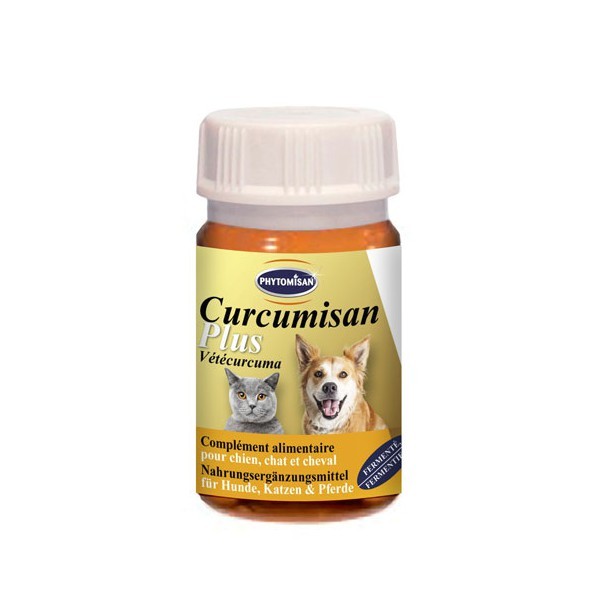
This turmeric-based supplement presented in powder form, Curcumisan Plus, will also improve digestion and ensure your dog's nervous balance. The many curcuminoids that compose it have been recognized for centuries for their anti-inflammatory properties and are reputed to prevent osteoarthritis.
Without side effects, Curcumisan Plus will be an ally for your dog, who will be able to continue to enjoy life to the full for your greatest happiness.
Curcumisan Plus is also effective for cats. For more info and to order : http://phytomisan.com/curcumisan-plus-en-poudre-50-g-pour-chiens-chats-chevaux/